The Stolen Party falls under the category of XYZ short stories. While there are many themes to be noticed on the surface, reading between the lines reveals even more.
One theme is naivete. Rosaura's naivete in believing that the occupants of the 'big house' view her as a friend is the most obvious; she doesn't seem to realize she's being deceived until the very end. Her persistence in trying to see the good in other people renders her blind to the fact that they only see her as someone of a lower class. Likewise, Senora Ines' naivete lies in believing that Rosaura knows her place in society, and that she volunteers to work at the party because of this. Her naivete, like Rosaura's, is shattered when she attempts to pay Rosaura for her efforts.
Another theme is power and resistance, which occurs multiple times throughout the story. In the beginning, Rosaura resists her mother's power over her when she states that she's going to Luciana's birthday; her mother attempts to reassert her power, but eventually gives in. During the party, Rosaura has power over the other guests when she hands out slices of cake; she gives out "the biggest pieces" to the people she likes, and "a slice so thin one could see through it" to a girl she argued with. Senora Ines also has some power during the party when she asks Rosaura to help her; she indirectly asserts her authority. At the end of the story, Rosaura resists both the power of Senora Ines and the power of social class when she refuses to accept payment from the senora.
A third theme, similar to naivete, is deception. When Rosaura goes to the party, she is deceived by the behavior of Luciana's family into thinking that she is viewed as a friend. Her naivete in believing the deception lasts until the last few paragraphs of the story. The magician hired for the party also has some deceptions of his own. With his card tricks, and making the monkey disappear, he is convincing people into believing the untrue. This is similar to the deception Rosaura falls for; both appear to be good things but in reality are no more than smoke and mirrors.
Tuesday, January 14, 2014

Saturday, January 11, 2014
Image four
http://us.123rf.com/400wm/400/400/egal/egal1210/egal121000036/15970979-autumn-falling-leaves-isolated-on-white-background.jpg
 Falling leaves make me think of how little control we actually have over some aspects of life. In autumn, leaves naturally start to change color and detach from their trees; people naturally start to change as they get older, both physically and mentally. Like the falling leaves, we can't control how we change. It's a response to our environment. Teenagers especially are easier to represent with this metaphor, because teen years are when you go through puberty; something you have no control over. Appearances begin to change as hormones activate and deactivate; this is similar to leaves shifting color as chlorophyll shuts down, depriving them of the greenish shades normally present.
 Falling leaves make me think of how little control we actually have over some aspects of life. In autumn, leaves naturally start to change color and detach from their trees; people naturally start to change as they get older, both physically and mentally. Like the falling leaves, we can't control how we change. It's a response to our environment. Teenagers especially are easier to represent with this metaphor, because teen years are when you go through puberty; something you have no control over. Appearances begin to change as hormones activate and deactivate; this is similar to leaves shifting color as chlorophyll shuts down, depriving them of the greenish shades normally present.
Sometimes you can't control what goes on in your thoughts, like who you like. That just seems to happen without warning. While this doesn't exactly happen with leaves, it's an involuntary response.
If leaves could 'control' how they shifted colors, and people could 'control' what goes on with their bodies and minds, life would start to become predictable. Some of the beauty in autumn lies in seeing what colors the leaves end up being, and the beauty in life is that it takes its own course with everyone- just like every tree's leaves fall at their own pace.
Monday, January 6, 2014
Best Books of 2013
While there was quite a lot of good literature published in 2013, three books stood out to me. These books made the list because they contain good plots, unique writing styles, and they're overall good books.
1. The Poisonwood Bible by Barbara Kingsolver. This book is written from the changing points of view of the wife and four daughters of a Protestant minister who travel to the Congo in 1959 as missionaries. Each of the narrators change through the course of the book (which spans thirty years), learning to accept differing religions and viewpoints based on their own decisions. Aside from character growth, there is an unexpected plot twist at the end which throws everything into a new light. A good plot is another reason why I enjoy this book.
2. Artemis Fowl: The Last Guardian by Eoin Colfer. The final book of the Artemis Fowl series comes with as many plot twists and unexpected happenings as the previous seven, but this is the book where human protagonist Artemis really changes the most in terms of character growth. When megalomaniac pixie Opal Koboi once again tries to destroy the fairy world, Artemis's plan involves himself making a huge sacrifice to save his friends- something he wouldn't have done previously without pressure from others. This shows how much his compassion for his friends and family has increased, which is a major change from the rather cold and emotionless boy before. The Last Guardian is written in Colfer's witty style, another reason why I enjoy this series.
3. The House of Hades by Rick Riordan. This book is witty, it is emotional, and sometimes downright hilarious. Picking up from the cliffhanger in The Mark of Athena, the crew of the Argo II are traveling to meet Percy and Annabeth at the Doors of Death- but not without some delays on both sides. The main reason I like this book is because of the changing relationships. First between Percy and Nico, which affects how the other characters see him (Nico), and the second between Leo and Calypso (this is a very sweet one because they actually are very similar). Hazel's acceptance of her half-brother and friend despite these relationships also shows that everyone should be given a chance, which is one of the underlying themes throughout both the Percy Jackson and Heroes of Olympus series.
All in all, these were some of my favorite books of 2013. They all have similar themes of acceptance, and the unique ways the authors chronicled the growth of their protagonists added to the good plots and made these books special.
1. The Poisonwood Bible by Barbara Kingsolver. This book is written from the changing points of view of the wife and four daughters of a Protestant minister who travel to the Congo in 1959 as missionaries. Each of the narrators change through the course of the book (which spans thirty years), learning to accept differing religions and viewpoints based on their own decisions. Aside from character growth, there is an unexpected plot twist at the end which throws everything into a new light. A good plot is another reason why I enjoy this book.
2. Artemis Fowl: The Last Guardian by Eoin Colfer. The final book of the Artemis Fowl series comes with as many plot twists and unexpected happenings as the previous seven, but this is the book where human protagonist Artemis really changes the most in terms of character growth. When megalomaniac pixie Opal Koboi once again tries to destroy the fairy world, Artemis's plan involves himself making a huge sacrifice to save his friends- something he wouldn't have done previously without pressure from others. This shows how much his compassion for his friends and family has increased, which is a major change from the rather cold and emotionless boy before. The Last Guardian is written in Colfer's witty style, another reason why I enjoy this series.
3. The House of Hades by Rick Riordan. This book is witty, it is emotional, and sometimes downright hilarious. Picking up from the cliffhanger in The Mark of Athena, the crew of the Argo II are traveling to meet Percy and Annabeth at the Doors of Death- but not without some delays on both sides. The main reason I like this book is because of the changing relationships. First between Percy and Nico, which affects how the other characters see him (Nico), and the second between Leo and Calypso (this is a very sweet one because they actually are very similar). Hazel's acceptance of her half-brother and friend despite these relationships also shows that everyone should be given a chance, which is one of the underlying themes throughout both the Percy Jackson and Heroes of Olympus series.
All in all, these were some of my favorite books of 2013. They all have similar themes of acceptance, and the unique ways the authors chronicled the growth of their protagonists added to the good plots and made these books special.
Tuesday, December 17, 2013
Image three
 https://blogger.googleusercontent.com/img/b/R29vZ2xl/AVvXsEgCym3dOH6r9vD_9SbwsAE2gEAiaTLGHrlEcnCQG1s8zG0pmnzELtopQqgtbyqR45bAGOD2Jpm2azsllFvlM-5UFVPuwBWUP8SCdPSMDZ3g4Vr1LNzJgbIVPMR6zftNL6bTmjeSaym4pyk/s1600/Black-Tulip-tulips-29859766-450-300.jpg
"I thought you could paint them." Lola handed the photograph to Vikki, who regarded it with interest. "It's different from what you usually paint, but they're really beautiful. My mama has an entire planter filled with them."
"Censina enjoys her idiosyncrasies," the artist murmured.
The young girl tilted her head. "Why are they called black tulips if they're dark purple?"
Vikki bit her lip, thinking. "Because they're...different. They stand out, and they don't seem to mind." At Lola's confusion, she gave her a half-smile. "You've seen how tall they grow, they're no wallflowers."
Lola giggled. "You remind me of one. A black tulip, I mean."
"Hm?"
"Well, you're different. No one else has mismatched eyes, and it makes you pretty. You don't care what people say about you, and you stand out." She paused. "It's like how these tulips stand out among the lighter ones. Like putting a charcoal stick between pink oil pastels."
Tuesday, November 26, 2013
How are minorities portrayed in books?
The treatment of minorities is a somewhat controversial issue, even now. Misogyny, 'gay bashings', and the Holocaust are all real-world, flesh-and-blood examples of how people have viewed others. One would think they would be a little more favorably portrayed in books; however, this isn't always the case. The portrayal of minorities tends to place them in unfavorable situations that focus more on their negative aspects, rather than highlighting the positive ones; in other words, they often receive an unfavorable portrayal.
One example of this is in the John Grisham novel The Brethren, which centers on three convicted judges extorting money from closet homosexuals. In several of these situations, outside help is called in to 'rescue' the extortion victims (mainly older, wealthy, white men). The extortion itself is despicable on many levels, but what bothers me is that these men cannot seem to get a grip. They all have experience in dealing with difficult issues (banking and politics, for example), and outmaneuvering opponents; the situation they have placed themselves in is rather similar to that. Their inability to extricate themselves makes them seem weaker than the straight men who are called on to help them, which is untrue. There is also a one-sided opinion on homosexuality throughout the book, provided by the homophobic justices running the scam. Other characters have a less obvious disdain of homosexuals, but no one steps up to protect them. Even though the book is set in the late 1990s and early 2000s, when major support groups had not really appeared in the U.S., there was support for the LGBTQ community, and that could have been written in somewhere.
Sexual discrimination was one of the factors in the Holocaust; homosexual men, having failed to create 'Aryan offspring', were often castrated after being sent to concentration camps. SS officers who were thought to be gay were shipped to a camp where they were killed.
Another example of unfavorable treatment is misogyny, which appears many times in the books I read. Women tend to be viewed as lesser than men, a view which unfortunately persists in the literary world. In the Artemis Fowl series, Holly Short, one of the protagonists, is discriminated against because of her gender. She receives less desirable police assignments than the male officers do, and even when she finds her way out of impossible situations, confidence is not placed in her abilities. While Holly does tend to be a wild card, multiple comments have been made about how females shouldn't be in the police force- even when the screwups aren't her fault.
Misogyny and gender stereotypes are still a part of world culture, despite the advancements and accomplishments made by women. Men are viewed as more 'socially valued' and competent than women; the gaps in wages remain. In African and Middle Eastern countries, men basically control everything their wives can do.
In conclusion, I found that minorities often receive unfavorable portrayals in books, similar to the real world.
One example of this is in the John Grisham novel The Brethren, which centers on three convicted judges extorting money from closet homosexuals. In several of these situations, outside help is called in to 'rescue' the extortion victims (mainly older, wealthy, white men). The extortion itself is despicable on many levels, but what bothers me is that these men cannot seem to get a grip. They all have experience in dealing with difficult issues (banking and politics, for example), and outmaneuvering opponents; the situation they have placed themselves in is rather similar to that. Their inability to extricate themselves makes them seem weaker than the straight men who are called on to help them, which is untrue. There is also a one-sided opinion on homosexuality throughout the book, provided by the homophobic justices running the scam. Other characters have a less obvious disdain of homosexuals, but no one steps up to protect them. Even though the book is set in the late 1990s and early 2000s, when major support groups had not really appeared in the U.S., there was support for the LGBTQ community, and that could have been written in somewhere.
Sexual discrimination was one of the factors in the Holocaust; homosexual men, having failed to create 'Aryan offspring', were often castrated after being sent to concentration camps. SS officers who were thought to be gay were shipped to a camp where they were killed.
Another example of unfavorable treatment is misogyny, which appears many times in the books I read. Women tend to be viewed as lesser than men, a view which unfortunately persists in the literary world. In the Artemis Fowl series, Holly Short, one of the protagonists, is discriminated against because of her gender. She receives less desirable police assignments than the male officers do, and even when she finds her way out of impossible situations, confidence is not placed in her abilities. While Holly does tend to be a wild card, multiple comments have been made about how females shouldn't be in the police force- even when the screwups aren't her fault.
Misogyny and gender stereotypes are still a part of world culture, despite the advancements and accomplishments made by women. Men are viewed as more 'socially valued' and competent than women; the gaps in wages remain. In African and Middle Eastern countries, men basically control everything their wives can do.
In conclusion, I found that minorities often receive unfavorable portrayals in books, similar to the real world.
Tuesday, November 19, 2013
Image two
http://myyearwithoutclothesshopping.com/wp-content/uploads/2012/06/dominoes-falling.jpghttp://myyearwithoutclothesshopping.com/shopping-clothes-emotions/how-one-small-decision-saved-me/attachment/dominoes-falling/
 (OK, this is very similar to Afrida's image of falling dominoes, but I was inspired.)
I feel as if dominoes can represent a very precarious situation, both literally and figuratively. With one push, a long line of dominoes can collapse in on itself; so can life. If you build up a series of lies that you base everything on, there are complications. Someone who finds enough information can expose you, and bam- there goes your entire career, tumbling like a knocked-over domino line.
A domino is made of a rather solid material, so you would expect some sturdiness; however, its design prevents it from being entirely so. Humans have survived for thousands of years, so one would expect us to be...sturdier, I guess. But people don't always learn, and the lines of dominoes keep getting built up and knocked down, over and over.
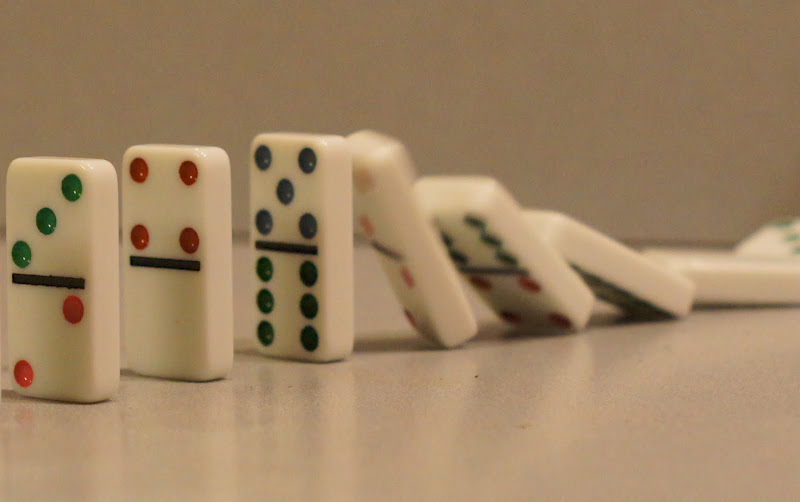
I feel as if dominoes can represent a very precarious situation, both literally and figuratively. With one push, a long line of dominoes can collapse in on itself; so can life. If you build up a series of lies that you base everything on, there are complications. Someone who finds enough information can expose you, and bam- there goes your entire career, tumbling like a knocked-over domino line.
A domino is made of a rather solid material, so you would expect some sturdiness; however, its design prevents it from being entirely so. Humans have survived for thousands of years, so one would expect us to be...sturdier, I guess. But people don't always learn, and the lines of dominoes keep getting built up and knocked down, over and over.
Thursday, November 14, 2013
Image one
 The clock had broken, and it was impossible to tell if it was night or day. Far in the distance, the clouds were colored a buttery orange, embraced on all sides by a softer gray shade. She could discern no hint of color in the trees below; it was probably right before dawn.
In the peaceful atmosphere, she had lost all sense of time. She watched the light reflect off the water, staring at the two small isles beyond the wooded peninsula where she had been sailing mere hours ago (if indeed they were hours).
Looking at the horizon, she let herself be immersed in the indescribable serenity of her surroundings. She wished they could stay at this moment in time forever, and not return to the bustling city. Even the ache of deviating from her familiar routines didn't disturb the silence.
She closed her eyes, listening to the waves wash distantly against the shore.
Subscribe to:
Posts (Atom)