The text I chose for my inquiry was the song 'Girls/Girls/Boys', by Panic! at the Disco. I decided to closely read the lyrics and see what the major and minor themes were, and I found that several intertwined. What themes could there be in this song?
Well, two major themes are love and acceptance, which really go hand-in-hand. In the song, love is the driving force behind the narrator's somewhat contradictory actions. He wants to protect his former girlfriend from people who might harm her ('But if you change your mind, you know where I am/Yeah, if you change your mind you know where to find me'); however, he's also in two minds about what she's done ('But I don't ever wanna be your boyfriend'). He cares about her a lot, going as far as defending her bisexuality ('Girls love girls and boys/And love is not a choice'). This is similar to real-life defense and support of the LGBT community, such as legalizing same-sex marriage.
This song could be the anthem for every bisexual woman across the world. Love isn't a choice, sexuality isn't a choice...this song portrays that through the narrator's thought processes.
The second major theme, acceptance, is also shown throughout the song. The narrator, despite his differing views on his girlfriend's choices, comes to accept the fact that she has a girlfriend ('They're close to finding out about your girlfriend...Girls love girls and boys'). He also accepts that love isn't a choice, due to his girlfriend's girlfriend and the fact that he's still in love with her (maybe because of their breakup).
Both of these themes are shown in the real world, especially on the topic of the LGBT community. Love within said community has been portrayed multiple times in the media (Cam and Mitchell on Modern Family, for example), and people are gradually coming to terms with it- an example of this is the seventeen states that have legalized same-sex marriage. However, others take a different view on the topic, such as the thirty-three states where non-heterosexual marriages are still illegal. A connection can be made to these states and the people persecuting the narrator's girlfriend ('They're close to finding out about your girlfriend').
Love isn't a choice, and that's a beautiful thing. If people would just realize that there's no stigma attached to not being straight, the theme of acceptance (if not necessarily love) would be widespread. We could learn to at least tolerate those who make different choices than us, like the narrator learns to.
Link to lyrics: http://www.azlyrics.com/lyrics/panicatthedisco/girlsgirlsboys.html
Showing posts with label theme/idea. Show all posts
Showing posts with label theme/idea. Show all posts
Tuesday, January 28, 2014

Tuesday, January 14, 2014
Synthesis Page: The Stolen Party
The Stolen Party falls under the category of XYZ short stories. While there are many themes to be noticed on the surface, reading between the lines reveals even more.
One theme is naivete. Rosaura's naivete in believing that the occupants of the 'big house' view her as a friend is the most obvious; she doesn't seem to realize she's being deceived until the very end. Her persistence in trying to see the good in other people renders her blind to the fact that they only see her as someone of a lower class. Likewise, Senora Ines' naivete lies in believing that Rosaura knows her place in society, and that she volunteers to work at the party because of this. Her naivete, like Rosaura's, is shattered when she attempts to pay Rosaura for her efforts.
Another theme is power and resistance, which occurs multiple times throughout the story. In the beginning, Rosaura resists her mother's power over her when she states that she's going to Luciana's birthday; her mother attempts to reassert her power, but eventually gives in. During the party, Rosaura has power over the other guests when she hands out slices of cake; she gives out "the biggest pieces" to the people she likes, and "a slice so thin one could see through it" to a girl she argued with. Senora Ines also has some power during the party when she asks Rosaura to help her; she indirectly asserts her authority. At the end of the story, Rosaura resists both the power of Senora Ines and the power of social class when she refuses to accept payment from the senora.
A third theme, similar to naivete, is deception. When Rosaura goes to the party, she is deceived by the behavior of Luciana's family into thinking that she is viewed as a friend. Her naivete in believing the deception lasts until the last few paragraphs of the story. The magician hired for the party also has some deceptions of his own. With his card tricks, and making the monkey disappear, he is convincing people into believing the untrue. This is similar to the deception Rosaura falls for; both appear to be good things but in reality are no more than smoke and mirrors.
One theme is naivete. Rosaura's naivete in believing that the occupants of the 'big house' view her as a friend is the most obvious; she doesn't seem to realize she's being deceived until the very end. Her persistence in trying to see the good in other people renders her blind to the fact that they only see her as someone of a lower class. Likewise, Senora Ines' naivete lies in believing that Rosaura knows her place in society, and that she volunteers to work at the party because of this. Her naivete, like Rosaura's, is shattered when she attempts to pay Rosaura for her efforts.
Another theme is power and resistance, which occurs multiple times throughout the story. In the beginning, Rosaura resists her mother's power over her when she states that she's going to Luciana's birthday; her mother attempts to reassert her power, but eventually gives in. During the party, Rosaura has power over the other guests when she hands out slices of cake; she gives out "the biggest pieces" to the people she likes, and "a slice so thin one could see through it" to a girl she argued with. Senora Ines also has some power during the party when she asks Rosaura to help her; she indirectly asserts her authority. At the end of the story, Rosaura resists both the power of Senora Ines and the power of social class when she refuses to accept payment from the senora.
A third theme, similar to naivete, is deception. When Rosaura goes to the party, she is deceived by the behavior of Luciana's family into thinking that she is viewed as a friend. Her naivete in believing the deception lasts until the last few paragraphs of the story. The magician hired for the party also has some deceptions of his own. With his card tricks, and making the monkey disappear, he is convincing people into believing the untrue. This is similar to the deception Rosaura falls for; both appear to be good things but in reality are no more than smoke and mirrors.
Saturday, January 11, 2014
Image four
http://us.123rf.com/400wm/400/400/egal/egal1210/egal121000036/15970979-autumn-falling-leaves-isolated-on-white-background.jpg
 Falling leaves make me think of how little control we actually have over some aspects of life. In autumn, leaves naturally start to change color and detach from their trees; people naturally start to change as they get older, both physically and mentally. Like the falling leaves, we can't control how we change. It's a response to our environment. Teenagers especially are easier to represent with this metaphor, because teen years are when you go through puberty; something you have no control over. Appearances begin to change as hormones activate and deactivate; this is similar to leaves shifting color as chlorophyll shuts down, depriving them of the greenish shades normally present.
 Falling leaves make me think of how little control we actually have over some aspects of life. In autumn, leaves naturally start to change color and detach from their trees; people naturally start to change as they get older, both physically and mentally. Like the falling leaves, we can't control how we change. It's a response to our environment. Teenagers especially are easier to represent with this metaphor, because teen years are when you go through puberty; something you have no control over. Appearances begin to change as hormones activate and deactivate; this is similar to leaves shifting color as chlorophyll shuts down, depriving them of the greenish shades normally present.
Sometimes you can't control what goes on in your thoughts, like who you like. That just seems to happen without warning. While this doesn't exactly happen with leaves, it's an involuntary response.
If leaves could 'control' how they shifted colors, and people could 'control' what goes on with their bodies and minds, life would start to become predictable. Some of the beauty in autumn lies in seeing what colors the leaves end up being, and the beauty in life is that it takes its own course with everyone- just like every tree's leaves fall at their own pace.
Tuesday, December 17, 2013
Image three
 https://blogger.googleusercontent.com/img/b/R29vZ2xl/AVvXsEgCym3dOH6r9vD_9SbwsAE2gEAiaTLGHrlEcnCQG1s8zG0pmnzELtopQqgtbyqR45bAGOD2Jpm2azsllFvlM-5UFVPuwBWUP8SCdPSMDZ3g4Vr1LNzJgbIVPMR6zftNL6bTmjeSaym4pyk/s1600/Black-Tulip-tulips-29859766-450-300.jpg
"I thought you could paint them." Lola handed the photograph to Vikki, who regarded it with interest. "It's different from what you usually paint, but they're really beautiful. My mama has an entire planter filled with them."
"Censina enjoys her idiosyncrasies," the artist murmured.
The young girl tilted her head. "Why are they called black tulips if they're dark purple?"
Vikki bit her lip, thinking. "Because they're...different. They stand out, and they don't seem to mind." At Lola's confusion, she gave her a half-smile. "You've seen how tall they grow, they're no wallflowers."
Lola giggled. "You remind me of one. A black tulip, I mean."
"Hm?"
"Well, you're different. No one else has mismatched eyes, and it makes you pretty. You don't care what people say about you, and you stand out." She paused. "It's like how these tulips stand out among the lighter ones. Like putting a charcoal stick between pink oil pastels."
Tuesday, November 19, 2013
Image two
http://myyearwithoutclothesshopping.com/wp-content/uploads/2012/06/dominoes-falling.jpghttp://myyearwithoutclothesshopping.com/shopping-clothes-emotions/how-one-small-decision-saved-me/attachment/dominoes-falling/
 (OK, this is very similar to Afrida's image of falling dominoes, but I was inspired.)
I feel as if dominoes can represent a very precarious situation, both literally and figuratively. With one push, a long line of dominoes can collapse in on itself; so can life. If you build up a series of lies that you base everything on, there are complications. Someone who finds enough information can expose you, and bam- there goes your entire career, tumbling like a knocked-over domino line.
A domino is made of a rather solid material, so you would expect some sturdiness; however, its design prevents it from being entirely so. Humans have survived for thousands of years, so one would expect us to be...sturdier, I guess. But people don't always learn, and the lines of dominoes keep getting built up and knocked down, over and over.
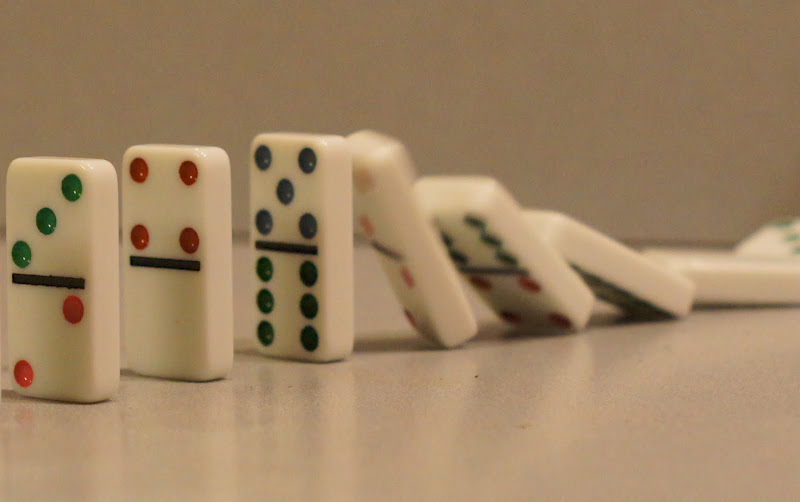
I feel as if dominoes can represent a very precarious situation, both literally and figuratively. With one push, a long line of dominoes can collapse in on itself; so can life. If you build up a series of lies that you base everything on, there are complications. Someone who finds enough information can expose you, and bam- there goes your entire career, tumbling like a knocked-over domino line.
A domino is made of a rather solid material, so you would expect some sturdiness; however, its design prevents it from being entirely so. Humans have survived for thousands of years, so one would expect us to be...sturdier, I guess. But people don't always learn, and the lines of dominoes keep getting built up and knocked down, over and over.
Tuesday, November 12, 2013
Social Justice in the Potterverse
Have you ever tried to 'read between the lines' in a wildly popular series? One that you've read over and over?
Take, for example, the Harry Potter series. This is probably the epitome of a series everyone has read (or watched). Many people choose to focus on the protagonists' growth and emotional development through the books; however, there are several social justice themes I find particularly interesting that appear in most of the series.
One major theme throughout the series is discrimination, especially against races viewed as 'lesser' than wizards. A particular species that fits this is the house-elves. Since Dobby's appearance in Chamber of Secrets, the rights of the house-elf have become an underlying theme in the story. They are often treated cruelly by their masters, being subjected to unusual punishments for straying out of line- Dobby's reference to shutting his ears in the oven for helping Harry is an example of this. Some are treated callously, as if they have no business existing- Sirius's indifference to Kreacher, as if he is a common household object, is another example. Yet they profess to be happy with their lot, and are nauseatingly grateful to the supposed kindness of their masters. (Dobby is probably the only exception to this rule.) Hermione, always the champion of equal rights, forms a group to get the elves a better situation; her determination for equality at age fourteen or so is admirable, especially when others refuse to acknowledge the house-elves' rather miserable situation.
Another form of discrimination is against Muggle-borns. Witches or wizards who come from an entirely nonmagical family are an uncommon group at Hogwarts, and are thought to be of a lesser status than half- or purebloods, thus having lesser magic. This is entirely untrue- Hermione, a Muggle-born, has more skill than Neville, a pureblood. Unfortunately, 'Mudbloods' are heavily discriminated against by their fellow wizards (take Malfoy's utter disdain of Hermione).
These themes of discrimination have parallels in reality. In the US, for example, African-Americans were historically discriminated against, such as the victims of the Holocaust- including Jewish citizens, homosexuals, 'Gypsies', and the disabled- were during the 1940s. In other countries, women have severely limited rights, such as the Potterverse's Muggle-borns and house-elves.
In conclusion, social justice in the Harry Potter series has parallels in reality. Many of these themes also come up in other series or stand-alone works; however, the Potterverse has more opportunity to explore these in detail. I believe that if J.K. Rowling had focused more on justice for characters that were discriminated against, she could create a very interesting and sensitive topic.
Take, for example, the Harry Potter series. This is probably the epitome of a series everyone has read (or watched). Many people choose to focus on the protagonists' growth and emotional development through the books; however, there are several social justice themes I find particularly interesting that appear in most of the series.
One major theme throughout the series is discrimination, especially against races viewed as 'lesser' than wizards. A particular species that fits this is the house-elves. Since Dobby's appearance in Chamber of Secrets, the rights of the house-elf have become an underlying theme in the story. They are often treated cruelly by their masters, being subjected to unusual punishments for straying out of line- Dobby's reference to shutting his ears in the oven for helping Harry is an example of this. Some are treated callously, as if they have no business existing- Sirius's indifference to Kreacher, as if he is a common household object, is another example. Yet they profess to be happy with their lot, and are nauseatingly grateful to the supposed kindness of their masters. (Dobby is probably the only exception to this rule.) Hermione, always the champion of equal rights, forms a group to get the elves a better situation; her determination for equality at age fourteen or so is admirable, especially when others refuse to acknowledge the house-elves' rather miserable situation.
Another form of discrimination is against Muggle-borns. Witches or wizards who come from an entirely nonmagical family are an uncommon group at Hogwarts, and are thought to be of a lesser status than half- or purebloods, thus having lesser magic. This is entirely untrue- Hermione, a Muggle-born, has more skill than Neville, a pureblood. Unfortunately, 'Mudbloods' are heavily discriminated against by their fellow wizards (take Malfoy's utter disdain of Hermione).
These themes of discrimination have parallels in reality. In the US, for example, African-Americans were historically discriminated against, such as the victims of the Holocaust- including Jewish citizens, homosexuals, 'Gypsies', and the disabled- were during the 1940s. In other countries, women have severely limited rights, such as the Potterverse's Muggle-borns and house-elves.
In conclusion, social justice in the Harry Potter series has parallels in reality. Many of these themes also come up in other series or stand-alone works; however, the Potterverse has more opportunity to explore these in detail. I believe that if J.K. Rowling had focused more on justice for characters that were discriminated against, she could create a very interesting and sensitive topic.
Monday, October 7, 2013
Personality v. Fitting In
Have you ever felt pressured to fit in, but you want to be recognized for who you are?
Welcome to J's world. J, the protagonist of the book I Am J, is seventeen years old, a junior in high school, and transgender. He's not gay; he believes he's a boy mistakenly born into a girl's body. No one understands this belief, and for much of the book J hides himself away under oversize sweaters and baggy jeans until he gains enough confidence to reveal his personality.
J and the people who helped him on his journey send an important message- teenagers (in books and real life) shouldn't hide who they really are. Personality is more important than fitting in.
A good example of this is J's one-time girlfriend Blue (Basia Karasinska). Blue is an artist who only paints using the color blue. Her entirely blue outfits, abstract paintings, and possibly the habit of eating her blue paint, have earned her the nickname "Blue" from her friends. During her appearances in I Am J, she makes no attempt to hide this (despite her mother's protests), even offering J some of her paint to eat when he visits. While she doesn't understand that J is transgender, I believe her confidence in showing who she is helped J to gain some of his own- after his 'coming-out', he recalls her old paintings and decides to exhibit some of his old photographs. The photographs he chooses include ones that show his transition into a male, and are seen by many people. Without Blue's confidence in her art, I think he would have been less willing to show his.
J himself undergoes many changes throughout the book. In the beginning, he is a shy and awkward teen who avoids socializing and the uncomfortable questions of his overprotective mom, who simply wants her little girl back. But after he leaves home and goes to an LGBTQ high school and support group, the friends he makes there give him the support he needs to explain his sexuality to his mother and let his personality shine through. This is shown when he gets accepted to a community college as a young man- while his also-transgender friend Chanelle (male-to-female, reverse of J) acted a man over the phone to sign him up, it was his idea to list himself as the gender he believes he is, male. Without confidence, he wouldn't have been able to bill himself as a man, or even sign up for college.
Before this, J's personality marked him as a 'freak'. Now he doesn't care about fitting in. I believe that teens can use him as an example. With a little support, anyone can be themselves and not be afraid.
Welcome to J's world. J, the protagonist of the book I Am J, is seventeen years old, a junior in high school, and transgender. He's not gay; he believes he's a boy mistakenly born into a girl's body. No one understands this belief, and for much of the book J hides himself away under oversize sweaters and baggy jeans until he gains enough confidence to reveal his personality.
J and the people who helped him on his journey send an important message- teenagers (in books and real life) shouldn't hide who they really are. Personality is more important than fitting in.
A good example of this is J's one-time girlfriend Blue (Basia Karasinska). Blue is an artist who only paints using the color blue. Her entirely blue outfits, abstract paintings, and possibly the habit of eating her blue paint, have earned her the nickname "Blue" from her friends. During her appearances in I Am J, she makes no attempt to hide this (despite her mother's protests), even offering J some of her paint to eat when he visits. While she doesn't understand that J is transgender, I believe her confidence in showing who she is helped J to gain some of his own- after his 'coming-out', he recalls her old paintings and decides to exhibit some of his old photographs. The photographs he chooses include ones that show his transition into a male, and are seen by many people. Without Blue's confidence in her art, I think he would have been less willing to show his.
J himself undergoes many changes throughout the book. In the beginning, he is a shy and awkward teen who avoids socializing and the uncomfortable questions of his overprotective mom, who simply wants her little girl back. But after he leaves home and goes to an LGBTQ high school and support group, the friends he makes there give him the support he needs to explain his sexuality to his mother and let his personality shine through. This is shown when he gets accepted to a community college as a young man- while his also-transgender friend Chanelle (male-to-female, reverse of J) acted a man over the phone to sign him up, it was his idea to list himself as the gender he believes he is, male. Without confidence, he wouldn't have been able to bill himself as a man, or even sign up for college.
Before this, J's personality marked him as a 'freak'. Now he doesn't care about fitting in. I believe that teens can use him as an example. With a little support, anyone can be themselves and not be afraid.
Subscribe to:
Posts (Atom)