The treatment of minorities is a somewhat controversial issue, even now. Misogyny, 'gay bashings', and the Holocaust are all real-world, flesh-and-blood examples of how people have viewed others. One would think they would be a little more favorably portrayed in books; however, this isn't always the case. The portrayal of minorities tends to place them in unfavorable situations that focus more on their negative aspects, rather than highlighting the positive ones; in other words, they often receive an unfavorable portrayal.
One example of this is in the John Grisham novel The Brethren, which centers on three convicted judges extorting money from closet homosexuals. In several of these situations, outside help is called in to 'rescue' the extortion victims (mainly older, wealthy, white men). The extortion itself is despicable on many levels, but what bothers me is that these men cannot seem to get a grip. They all have experience in dealing with difficult issues (banking and politics, for example), and outmaneuvering opponents; the situation they have placed themselves in is rather similar to that. Their inability to extricate themselves makes them seem weaker than the straight men who are called on to help them, which is untrue. There is also a one-sided opinion on homosexuality throughout the book, provided by the homophobic justices running the scam. Other characters have a less obvious disdain of homosexuals, but no one steps up to protect them. Even though the book is set in the late 1990s and early 2000s, when major support groups had not really appeared in the U.S., there was support for the LGBTQ community, and that could have been written in somewhere.
Sexual discrimination was one of the factors in the Holocaust; homosexual men, having failed to create 'Aryan offspring', were often castrated after being sent to concentration camps. SS officers who were thought to be gay were shipped to a camp where they were killed.
Another example of unfavorable treatment is misogyny, which appears many times in the books I read. Women tend to be viewed as lesser than men, a view which unfortunately persists in the literary world. In the Artemis Fowl series, Holly Short, one of the protagonists, is discriminated against because of her gender. She receives less desirable police assignments than the male officers do, and even when she finds her way out of impossible situations, confidence is not placed in her abilities. While Holly does tend to be a wild card, multiple comments have been made about how females shouldn't be in the police force- even when the screwups aren't her fault.
Misogyny and gender stereotypes are still a part of world culture, despite the advancements and accomplishments made by women. Men are viewed as more 'socially valued' and competent than women; the gaps in wages remain. In African and Middle Eastern countries, men basically control everything their wives can do.
In conclusion, I found that minorities often receive unfavorable portrayals in books, similar to the real world.
Tuesday, November 26, 2013

Tuesday, November 19, 2013
Image two
http://myyearwithoutclothesshopping.com/wp-content/uploads/2012/06/dominoes-falling.jpghttp://myyearwithoutclothesshopping.com/shopping-clothes-emotions/how-one-small-decision-saved-me/attachment/dominoes-falling/
 (OK, this is very similar to Afrida's image of falling dominoes, but I was inspired.)
I feel as if dominoes can represent a very precarious situation, both literally and figuratively. With one push, a long line of dominoes can collapse in on itself; so can life. If you build up a series of lies that you base everything on, there are complications. Someone who finds enough information can expose you, and bam- there goes your entire career, tumbling like a knocked-over domino line.
A domino is made of a rather solid material, so you would expect some sturdiness; however, its design prevents it from being entirely so. Humans have survived for thousands of years, so one would expect us to be...sturdier, I guess. But people don't always learn, and the lines of dominoes keep getting built up and knocked down, over and over.
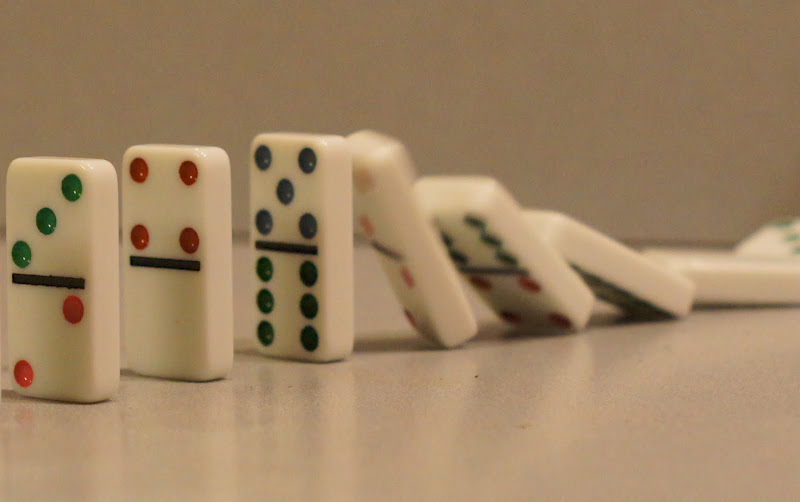
I feel as if dominoes can represent a very precarious situation, both literally and figuratively. With one push, a long line of dominoes can collapse in on itself; so can life. If you build up a series of lies that you base everything on, there are complications. Someone who finds enough information can expose you, and bam- there goes your entire career, tumbling like a knocked-over domino line.
A domino is made of a rather solid material, so you would expect some sturdiness; however, its design prevents it from being entirely so. Humans have survived for thousands of years, so one would expect us to be...sturdier, I guess. But people don't always learn, and the lines of dominoes keep getting built up and knocked down, over and over.
Thursday, November 14, 2013
Image one
 The clock had broken, and it was impossible to tell if it was night or day. Far in the distance, the clouds were colored a buttery orange, embraced on all sides by a softer gray shade. She could discern no hint of color in the trees below; it was probably right before dawn.
In the peaceful atmosphere, she had lost all sense of time. She watched the light reflect off the water, staring at the two small isles beyond the wooded peninsula where she had been sailing mere hours ago (if indeed they were hours).
Looking at the horizon, she let herself be immersed in the indescribable serenity of her surroundings. She wished they could stay at this moment in time forever, and not return to the bustling city. Even the ache of deviating from her familiar routines didn't disturb the silence.
She closed her eyes, listening to the waves wash distantly against the shore.
Tuesday, November 12, 2013
Social Justice in the Potterverse
Have you ever tried to 'read between the lines' in a wildly popular series? One that you've read over and over?
Take, for example, the Harry Potter series. This is probably the epitome of a series everyone has read (or watched). Many people choose to focus on the protagonists' growth and emotional development through the books; however, there are several social justice themes I find particularly interesting that appear in most of the series.
One major theme throughout the series is discrimination, especially against races viewed as 'lesser' than wizards. A particular species that fits this is the house-elves. Since Dobby's appearance in Chamber of Secrets, the rights of the house-elf have become an underlying theme in the story. They are often treated cruelly by their masters, being subjected to unusual punishments for straying out of line- Dobby's reference to shutting his ears in the oven for helping Harry is an example of this. Some are treated callously, as if they have no business existing- Sirius's indifference to Kreacher, as if he is a common household object, is another example. Yet they profess to be happy with their lot, and are nauseatingly grateful to the supposed kindness of their masters. (Dobby is probably the only exception to this rule.) Hermione, always the champion of equal rights, forms a group to get the elves a better situation; her determination for equality at age fourteen or so is admirable, especially when others refuse to acknowledge the house-elves' rather miserable situation.
Another form of discrimination is against Muggle-borns. Witches or wizards who come from an entirely nonmagical family are an uncommon group at Hogwarts, and are thought to be of a lesser status than half- or purebloods, thus having lesser magic. This is entirely untrue- Hermione, a Muggle-born, has more skill than Neville, a pureblood. Unfortunately, 'Mudbloods' are heavily discriminated against by their fellow wizards (take Malfoy's utter disdain of Hermione).
These themes of discrimination have parallels in reality. In the US, for example, African-Americans were historically discriminated against, such as the victims of the Holocaust- including Jewish citizens, homosexuals, 'Gypsies', and the disabled- were during the 1940s. In other countries, women have severely limited rights, such as the Potterverse's Muggle-borns and house-elves.
In conclusion, social justice in the Harry Potter series has parallels in reality. Many of these themes also come up in other series or stand-alone works; however, the Potterverse has more opportunity to explore these in detail. I believe that if J.K. Rowling had focused more on justice for characters that were discriminated against, she could create a very interesting and sensitive topic.
Take, for example, the Harry Potter series. This is probably the epitome of a series everyone has read (or watched). Many people choose to focus on the protagonists' growth and emotional development through the books; however, there are several social justice themes I find particularly interesting that appear in most of the series.
One major theme throughout the series is discrimination, especially against races viewed as 'lesser' than wizards. A particular species that fits this is the house-elves. Since Dobby's appearance in Chamber of Secrets, the rights of the house-elf have become an underlying theme in the story. They are often treated cruelly by their masters, being subjected to unusual punishments for straying out of line- Dobby's reference to shutting his ears in the oven for helping Harry is an example of this. Some are treated callously, as if they have no business existing- Sirius's indifference to Kreacher, as if he is a common household object, is another example. Yet they profess to be happy with their lot, and are nauseatingly grateful to the supposed kindness of their masters. (Dobby is probably the only exception to this rule.) Hermione, always the champion of equal rights, forms a group to get the elves a better situation; her determination for equality at age fourteen or so is admirable, especially when others refuse to acknowledge the house-elves' rather miserable situation.
Another form of discrimination is against Muggle-borns. Witches or wizards who come from an entirely nonmagical family are an uncommon group at Hogwarts, and are thought to be of a lesser status than half- or purebloods, thus having lesser magic. This is entirely untrue- Hermione, a Muggle-born, has more skill than Neville, a pureblood. Unfortunately, 'Mudbloods' are heavily discriminated against by their fellow wizards (take Malfoy's utter disdain of Hermione).
These themes of discrimination have parallels in reality. In the US, for example, African-Americans were historically discriminated against, such as the victims of the Holocaust- including Jewish citizens, homosexuals, 'Gypsies', and the disabled- were during the 1940s. In other countries, women have severely limited rights, such as the Potterverse's Muggle-borns and house-elves.
In conclusion, social justice in the Harry Potter series has parallels in reality. Many of these themes also come up in other series or stand-alone works; however, the Potterverse has more opportunity to explore these in detail. I believe that if J.K. Rowling had focused more on justice for characters that were discriminated against, she could create a very interesting and sensitive topic.
Subscribe to:
Posts (Atom)