The treatment of minorities is a somewhat controversial issue, even now. Misogyny, 'gay bashings', and the Holocaust are all real-world, flesh-and-blood examples of how people have viewed others. One would think they would be a little more favorably portrayed in books; however, this isn't always the case. The portrayal of minorities tends to place them in unfavorable situations that focus more on their negative aspects, rather than highlighting the positive ones; in other words, they often receive an unfavorable portrayal.
One example of this is in the John Grisham novel The Brethren, which centers on three convicted judges extorting money from closet homosexuals. In several of these situations, outside help is called in to 'rescue' the extortion victims (mainly older, wealthy, white men). The extortion itself is despicable on many levels, but what bothers me is that these men cannot seem to get a grip. They all have experience in dealing with difficult issues (banking and politics, for example), and outmaneuvering opponents; the situation they have placed themselves in is rather similar to that. Their inability to extricate themselves makes them seem weaker than the straight men who are called on to help them, which is untrue. There is also a one-sided opinion on homosexuality throughout the book, provided by the homophobic justices running the scam. Other characters have a less obvious disdain of homosexuals, but no one steps up to protect them. Even though the book is set in the late 1990s and early 2000s, when major support groups had not really appeared in the U.S., there was support for the LGBTQ community, and that could have been written in somewhere.
Sexual discrimination was one of the factors in the Holocaust; homosexual men, having failed to create 'Aryan offspring', were often castrated after being sent to concentration camps. SS officers who were thought to be gay were shipped to a camp where they were killed.
Another example of unfavorable treatment is misogyny, which appears many times in the books I read. Women tend to be viewed as lesser than men, a view which unfortunately persists in the literary world. In the Artemis Fowl series, Holly Short, one of the protagonists, is discriminated against because of her gender. She receives less desirable police assignments than the male officers do, and even when she finds her way out of impossible situations, confidence is not placed in her abilities. While Holly does tend to be a wild card, multiple comments have been made about how females shouldn't be in the police force- even when the screwups aren't her fault.
Misogyny and gender stereotypes are still a part of world culture, despite the advancements and accomplishments made by women. Men are viewed as more 'socially valued' and competent than women; the gaps in wages remain. In African and Middle Eastern countries, men basically control everything their wives can do.
In conclusion, I found that minorities often receive unfavorable portrayals in books, similar to the real world.
Tuesday, November 26, 2013

Tuesday, November 19, 2013
Image two
http://myyearwithoutclothesshopping.com/wp-content/uploads/2012/06/dominoes-falling.jpghttp://myyearwithoutclothesshopping.com/shopping-clothes-emotions/how-one-small-decision-saved-me/attachment/dominoes-falling/
 (OK, this is very similar to Afrida's image of falling dominoes, but I was inspired.)
I feel as if dominoes can represent a very precarious situation, both literally and figuratively. With one push, a long line of dominoes can collapse in on itself; so can life. If you build up a series of lies that you base everything on, there are complications. Someone who finds enough information can expose you, and bam- there goes your entire career, tumbling like a knocked-over domino line.
A domino is made of a rather solid material, so you would expect some sturdiness; however, its design prevents it from being entirely so. Humans have survived for thousands of years, so one would expect us to be...sturdier, I guess. But people don't always learn, and the lines of dominoes keep getting built up and knocked down, over and over.
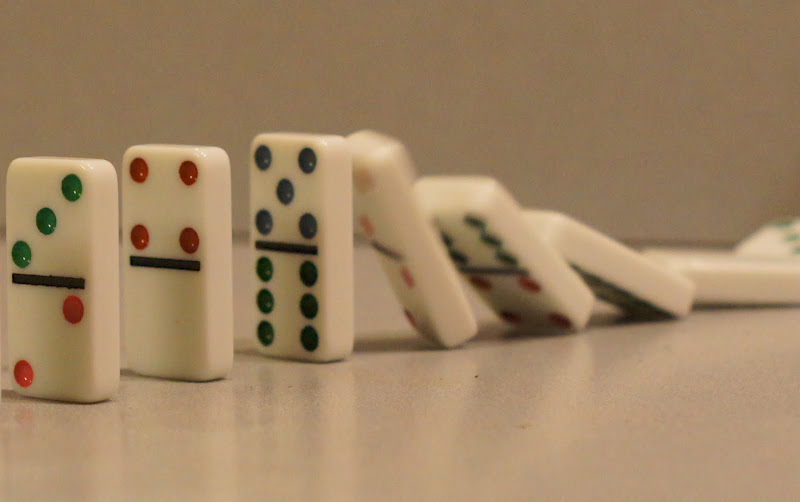
I feel as if dominoes can represent a very precarious situation, both literally and figuratively. With one push, a long line of dominoes can collapse in on itself; so can life. If you build up a series of lies that you base everything on, there are complications. Someone who finds enough information can expose you, and bam- there goes your entire career, tumbling like a knocked-over domino line.
A domino is made of a rather solid material, so you would expect some sturdiness; however, its design prevents it from being entirely so. Humans have survived for thousands of years, so one would expect us to be...sturdier, I guess. But people don't always learn, and the lines of dominoes keep getting built up and knocked down, over and over.
Thursday, November 14, 2013
Image one
 The clock had broken, and it was impossible to tell if it was night or day. Far in the distance, the clouds were colored a buttery orange, embraced on all sides by a softer gray shade. She could discern no hint of color in the trees below; it was probably right before dawn.
In the peaceful atmosphere, she had lost all sense of time. She watched the light reflect off the water, staring at the two small isles beyond the wooded peninsula where she had been sailing mere hours ago (if indeed they were hours).
Looking at the horizon, she let herself be immersed in the indescribable serenity of her surroundings. She wished they could stay at this moment in time forever, and not return to the bustling city. Even the ache of deviating from her familiar routines didn't disturb the silence.
She closed her eyes, listening to the waves wash distantly against the shore.
Tuesday, November 12, 2013
Social Justice in the Potterverse
Have you ever tried to 'read between the lines' in a wildly popular series? One that you've read over and over?
Take, for example, the Harry Potter series. This is probably the epitome of a series everyone has read (or watched). Many people choose to focus on the protagonists' growth and emotional development through the books; however, there are several social justice themes I find particularly interesting that appear in most of the series.
One major theme throughout the series is discrimination, especially against races viewed as 'lesser' than wizards. A particular species that fits this is the house-elves. Since Dobby's appearance in Chamber of Secrets, the rights of the house-elf have become an underlying theme in the story. They are often treated cruelly by their masters, being subjected to unusual punishments for straying out of line- Dobby's reference to shutting his ears in the oven for helping Harry is an example of this. Some are treated callously, as if they have no business existing- Sirius's indifference to Kreacher, as if he is a common household object, is another example. Yet they profess to be happy with their lot, and are nauseatingly grateful to the supposed kindness of their masters. (Dobby is probably the only exception to this rule.) Hermione, always the champion of equal rights, forms a group to get the elves a better situation; her determination for equality at age fourteen or so is admirable, especially when others refuse to acknowledge the house-elves' rather miserable situation.
Another form of discrimination is against Muggle-borns. Witches or wizards who come from an entirely nonmagical family are an uncommon group at Hogwarts, and are thought to be of a lesser status than half- or purebloods, thus having lesser magic. This is entirely untrue- Hermione, a Muggle-born, has more skill than Neville, a pureblood. Unfortunately, 'Mudbloods' are heavily discriminated against by their fellow wizards (take Malfoy's utter disdain of Hermione).
These themes of discrimination have parallels in reality. In the US, for example, African-Americans were historically discriminated against, such as the victims of the Holocaust- including Jewish citizens, homosexuals, 'Gypsies', and the disabled- were during the 1940s. In other countries, women have severely limited rights, such as the Potterverse's Muggle-borns and house-elves.
In conclusion, social justice in the Harry Potter series has parallels in reality. Many of these themes also come up in other series or stand-alone works; however, the Potterverse has more opportunity to explore these in detail. I believe that if J.K. Rowling had focused more on justice for characters that were discriminated against, she could create a very interesting and sensitive topic.
Take, for example, the Harry Potter series. This is probably the epitome of a series everyone has read (or watched). Many people choose to focus on the protagonists' growth and emotional development through the books; however, there are several social justice themes I find particularly interesting that appear in most of the series.
One major theme throughout the series is discrimination, especially against races viewed as 'lesser' than wizards. A particular species that fits this is the house-elves. Since Dobby's appearance in Chamber of Secrets, the rights of the house-elf have become an underlying theme in the story. They are often treated cruelly by their masters, being subjected to unusual punishments for straying out of line- Dobby's reference to shutting his ears in the oven for helping Harry is an example of this. Some are treated callously, as if they have no business existing- Sirius's indifference to Kreacher, as if he is a common household object, is another example. Yet they profess to be happy with their lot, and are nauseatingly grateful to the supposed kindness of their masters. (Dobby is probably the only exception to this rule.) Hermione, always the champion of equal rights, forms a group to get the elves a better situation; her determination for equality at age fourteen or so is admirable, especially when others refuse to acknowledge the house-elves' rather miserable situation.
Another form of discrimination is against Muggle-borns. Witches or wizards who come from an entirely nonmagical family are an uncommon group at Hogwarts, and are thought to be of a lesser status than half- or purebloods, thus having lesser magic. This is entirely untrue- Hermione, a Muggle-born, has more skill than Neville, a pureblood. Unfortunately, 'Mudbloods' are heavily discriminated against by their fellow wizards (take Malfoy's utter disdain of Hermione).
These themes of discrimination have parallels in reality. In the US, for example, African-Americans were historically discriminated against, such as the victims of the Holocaust- including Jewish citizens, homosexuals, 'Gypsies', and the disabled- were during the 1940s. In other countries, women have severely limited rights, such as the Potterverse's Muggle-borns and house-elves.
In conclusion, social justice in the Harry Potter series has parallels in reality. Many of these themes also come up in other series or stand-alone works; however, the Potterverse has more opportunity to explore these in detail. I believe that if J.K. Rowling had focused more on justice for characters that were discriminated against, she could create a very interesting and sensitive topic.
Thursday, October 17, 2013
An Analysis of Names
The YA novel Hero by Perry Moore is about Thom, a gay teenager with superpowers who deals with the disdain of his father and his fellow heroes while coming to terms with who he is. While I was reading this book, I noticed that the names of several characters have a connection to their personality, or are simply interesting. So here is my analysis of their names.
Thom Creed
Thom's first name is a short form of Thomas, meaning "twin" in Greek. This is connected with his inner struggle- one half of mind wants to please his father, while the other wants to be who he is. Since twins may be referred to as two halves, this is an accurate first name. His surname, Creed, means "a statement of beliefs, principles, or opinions", something Thom doesn't really do until near the end of the book. It seems that the twins need to reconcile in order to state their beliefs.
Ruth Whitliff
Ruth, an elderly woman who can see the future, is Thom's first friend within the legion of superheroes. Her first name means "friendship" in Hebrew- this has to be more than a coincidence. (Whitliff doesn't seem to have any specific meaning; simply an aristocratic name that reflects her upper-middle-class ancestry.)
Hal and Lila Creed
Hal, a diminutive form of Harold, is an English name meaning "army ruler". This connects with his army service, but also his leader-type demeanor*. Lila is a Persian name meaning "lilac tree", but it can also mean "night" or "you are mine" in Hebrew. The flower name connects with the scent of gardenias Thom associates with his mother; "night" can be connected with the time she returned to visit him, or the time of day she left her family. An army leader and a night flower seems like an unlikely combination, but she is still his to the end.
Miss Scarlett and Typhoid Larry
Two of Thom's team members, Scarlett and Larry are two of the unlikeliest people to become friends. Scarlett is an English name meaning "red", but a better meaning is associated with Scarlett O'Hara from Gone With the Wind. Mr. Moore's Scarlett has inherited Ms. O'Hara's "cold-blooded tenacity" and flirtatious manner, as well as a penchant for the color red. Typhoid Larry, who can infect people with a handshake, is a parody of Typhoid Mary, the Irish cook who allegedly infected 50 people with her cooking. Larry is also a short form of Lawrence, an English name meaning "laurel". A laurel wreath was historically awarded to game champions or victors of a battle; Larry's sacrificing himself to save the world earns him a posthumous, metaphorical laurel wreath from Thom.
Golden Boy and Uberman
Uberman's name states who he is; the personification of masculinity (especially in Thom's eyes). Golden Boy's name does much the same; he's the sidekick doing everything he can to maintain a good image for his superiors, and in the beginning of the book, he's "nauseatingly kiss-ass" in Thom's opinion. His first name, Kevin, means "handsome" in Irish, connecting with his good looks- and it's this handsome, unusually successful young man** who wins Scarlett's heart (much like Scarlett and Rhett in Gone With the Wind).
Justice and Goran
Justice is a parody of Superman, from the alien ancestry to being adopted by older farmers in Kansas. He means to bring justice to Earth, and he does; at least until he decides he wants justice for his destroyed planet and nearly blows up the Earth in the process. Goran, the basketball player from Croatia, is an enigmatic young man who also wants his own justice, becoming a vigilante hero in the process. His name can metaphorically mean "the big/tall one", which reflects his imposing size.
*Hal's superhero alias was 'Major Might'; his first name ties in neatly with this.
**The expression 'golden boy' means someone who is unusually successful at an early age. Kevin's hero status, at the age of nineteen or so, is pretty successful, considering the fact that he's an orphan of unknown race.
Thom Creed
Thom's first name is a short form of Thomas, meaning "twin" in Greek. This is connected with his inner struggle- one half of mind wants to please his father, while the other wants to be who he is. Since twins may be referred to as two halves, this is an accurate first name. His surname, Creed, means "a statement of beliefs, principles, or opinions", something Thom doesn't really do until near the end of the book. It seems that the twins need to reconcile in order to state their beliefs.
Ruth Whitliff
Ruth, an elderly woman who can see the future, is Thom's first friend within the legion of superheroes. Her first name means "friendship" in Hebrew- this has to be more than a coincidence. (Whitliff doesn't seem to have any specific meaning; simply an aristocratic name that reflects her upper-middle-class ancestry.)
Hal and Lila Creed
Hal, a diminutive form of Harold, is an English name meaning "army ruler". This connects with his army service, but also his leader-type demeanor*. Lila is a Persian name meaning "lilac tree", but it can also mean "night" or "you are mine" in Hebrew. The flower name connects with the scent of gardenias Thom associates with his mother; "night" can be connected with the time she returned to visit him, or the time of day she left her family. An army leader and a night flower seems like an unlikely combination, but she is still his to the end.
Miss Scarlett and Typhoid Larry
Two of Thom's team members, Scarlett and Larry are two of the unlikeliest people to become friends. Scarlett is an English name meaning "red", but a better meaning is associated with Scarlett O'Hara from Gone With the Wind. Mr. Moore's Scarlett has inherited Ms. O'Hara's "cold-blooded tenacity" and flirtatious manner, as well as a penchant for the color red. Typhoid Larry, who can infect people with a handshake, is a parody of Typhoid Mary, the Irish cook who allegedly infected 50 people with her cooking. Larry is also a short form of Lawrence, an English name meaning "laurel". A laurel wreath was historically awarded to game champions or victors of a battle; Larry's sacrificing himself to save the world earns him a posthumous, metaphorical laurel wreath from Thom.
Golden Boy and Uberman
Uberman's name states who he is; the personification of masculinity (especially in Thom's eyes). Golden Boy's name does much the same; he's the sidekick doing everything he can to maintain a good image for his superiors, and in the beginning of the book, he's "nauseatingly kiss-ass" in Thom's opinion. His first name, Kevin, means "handsome" in Irish, connecting with his good looks- and it's this handsome, unusually successful young man** who wins Scarlett's heart (much like Scarlett and Rhett in Gone With the Wind).
Justice and Goran
Justice is a parody of Superman, from the alien ancestry to being adopted by older farmers in Kansas. He means to bring justice to Earth, and he does; at least until he decides he wants justice for his destroyed planet and nearly blows up the Earth in the process. Goran, the basketball player from Croatia, is an enigmatic young man who also wants his own justice, becoming a vigilante hero in the process. His name can metaphorically mean "the big/tall one", which reflects his imposing size.
*Hal's superhero alias was 'Major Might'; his first name ties in neatly with this.
**The expression 'golden boy' means someone who is unusually successful at an early age. Kevin's hero status, at the age of nineteen or so, is pretty successful, considering the fact that he's an orphan of unknown race.
"Sick Lit Books Aimed at Children"- summary
The Daily Mail article "Sick Lit Books Aimed at Children", by Tanith Carey, presents the idea that YA books about darker issues are not good for teenagers. Ms. Carey presents her idea by paraphrasing the plots of several books that deal with "the harsh realities of terminal illness, depression, and death"- namely, The Fault In Our Stars, Never Eighteen, and Before I Die. She continues by talking about books that deal with suicide; specifically how there are entire books on the subject when other forms of media will gloss over it "for fear of encouraging copycat behavior". She calls such books "morbid" and "mawkish", saying that using teenagers with severe situations to build dramatic tension is "distasteful". She concludes with a quote from a child psychologist: "Let's hope publishers do have young people's interests at heart- and they are not selling books by sensationalizing children's suffering."
Ms. Carey uses many craft moves to convey her ideas. Her tone is disdainful towards these books and their publishers- she uses loaded words such as "disdainful", "morbid", "exploitative", and "questionable". She quotes psychologists who agree with her opinion, while also addressing the counterclaim with quotes from others who have opposing views on the subject. She urges parents to check up on their children's reading habits; her tone is sympathetic towards them.
While her article is well-written, I disagree with her. I think it's important for young adults to read books addressing darker themes. Things such as death and illness are part of life, and it's easier to connect with a protagonist who is going through the same troubles. Reading about subjects such as suicidal depression and self-harm doesn't encourage the reader to start cutting...which is why the term 'sick-lit' stood out to me. Is everything not about vampires and supernatural stuff unhealthy for teens?
Ms. Carey uses many craft moves to convey her ideas. Her tone is disdainful towards these books and their publishers- she uses loaded words such as "disdainful", "morbid", "exploitative", and "questionable". She quotes psychologists who agree with her opinion, while also addressing the counterclaim with quotes from others who have opposing views on the subject. She urges parents to check up on their children's reading habits; her tone is sympathetic towards them.
While her article is well-written, I disagree with her. I think it's important for young adults to read books addressing darker themes. Things such as death and illness are part of life, and it's easier to connect with a protagonist who is going through the same troubles. Reading about subjects such as suicidal depression and self-harm doesn't encourage the reader to start cutting...which is why the term 'sick-lit' stood out to me. Is everything not about vampires and supernatural stuff unhealthy for teens?
Monday, October 7, 2013
Personality v. Fitting In
Have you ever felt pressured to fit in, but you want to be recognized for who you are?
Welcome to J's world. J, the protagonist of the book I Am J, is seventeen years old, a junior in high school, and transgender. He's not gay; he believes he's a boy mistakenly born into a girl's body. No one understands this belief, and for much of the book J hides himself away under oversize sweaters and baggy jeans until he gains enough confidence to reveal his personality.
J and the people who helped him on his journey send an important message- teenagers (in books and real life) shouldn't hide who they really are. Personality is more important than fitting in.
A good example of this is J's one-time girlfriend Blue (Basia Karasinska). Blue is an artist who only paints using the color blue. Her entirely blue outfits, abstract paintings, and possibly the habit of eating her blue paint, have earned her the nickname "Blue" from her friends. During her appearances in I Am J, she makes no attempt to hide this (despite her mother's protests), even offering J some of her paint to eat when he visits. While she doesn't understand that J is transgender, I believe her confidence in showing who she is helped J to gain some of his own- after his 'coming-out', he recalls her old paintings and decides to exhibit some of his old photographs. The photographs he chooses include ones that show his transition into a male, and are seen by many people. Without Blue's confidence in her art, I think he would have been less willing to show his.
J himself undergoes many changes throughout the book. In the beginning, he is a shy and awkward teen who avoids socializing and the uncomfortable questions of his overprotective mom, who simply wants her little girl back. But after he leaves home and goes to an LGBTQ high school and support group, the friends he makes there give him the support he needs to explain his sexuality to his mother and let his personality shine through. This is shown when he gets accepted to a community college as a young man- while his also-transgender friend Chanelle (male-to-female, reverse of J) acted a man over the phone to sign him up, it was his idea to list himself as the gender he believes he is, male. Without confidence, he wouldn't have been able to bill himself as a man, or even sign up for college.
Before this, J's personality marked him as a 'freak'. Now he doesn't care about fitting in. I believe that teens can use him as an example. With a little support, anyone can be themselves and not be afraid.
Welcome to J's world. J, the protagonist of the book I Am J, is seventeen years old, a junior in high school, and transgender. He's not gay; he believes he's a boy mistakenly born into a girl's body. No one understands this belief, and for much of the book J hides himself away under oversize sweaters and baggy jeans until he gains enough confidence to reveal his personality.
J and the people who helped him on his journey send an important message- teenagers (in books and real life) shouldn't hide who they really are. Personality is more important than fitting in.
A good example of this is J's one-time girlfriend Blue (Basia Karasinska). Blue is an artist who only paints using the color blue. Her entirely blue outfits, abstract paintings, and possibly the habit of eating her blue paint, have earned her the nickname "Blue" from her friends. During her appearances in I Am J, she makes no attempt to hide this (despite her mother's protests), even offering J some of her paint to eat when he visits. While she doesn't understand that J is transgender, I believe her confidence in showing who she is helped J to gain some of his own- after his 'coming-out', he recalls her old paintings and decides to exhibit some of his old photographs. The photographs he chooses include ones that show his transition into a male, and are seen by many people. Without Blue's confidence in her art, I think he would have been less willing to show his.
J himself undergoes many changes throughout the book. In the beginning, he is a shy and awkward teen who avoids socializing and the uncomfortable questions of his overprotective mom, who simply wants her little girl back. But after he leaves home and goes to an LGBTQ high school and support group, the friends he makes there give him the support he needs to explain his sexuality to his mother and let his personality shine through. This is shown when he gets accepted to a community college as a young man- while his also-transgender friend Chanelle (male-to-female, reverse of J) acted a man over the phone to sign him up, it was his idea to list himself as the gender he believes he is, male. Without confidence, he wouldn't have been able to bill himself as a man, or even sign up for college.
Before this, J's personality marked him as a 'freak'. Now he doesn't care about fitting in. I believe that teens can use him as an example. With a little support, anyone can be themselves and not be afraid.
Subscribe to:
Posts (Atom)